Pregnancy Companion
Welcome to Maternl
To help us understand who we're reaching and better direct resources, please tell us which country you're visiting from. This is required to continue.
There are great differences throughout the world and within countries themselves in pregnancy outcomes as measured by stillbirth rtes, maternal mortality rates and infant mortality rates. Root causes for these differences include -but are not limited to-failure to understand the processes of pregnancy and the post-partum period, the lack of access to prenatal care centers and maternity centers and the unconscious bias and disparities in care ofvulnerable poulations. It is the singular goal of Maternl to address the universal need for all pregnant women and their families to have immediately available maternal and child healthcare information, education, and access to prenatal, maternity and post partum healthcare. Although it is a program for every woman, every family, it's mission is particularly focused on improving and facilitating early entry into prenatal healthcare services for vulnerable, disadvantaged and geogrpahocally diverse families, world-wide.
Maternl is different from other pregnancy apps. Maternl is a unique, visionary and transformative AI guided companion strengtened and shaped with experience, humanism, empathy, and deep understanding by its founder and creator. Maternl will be your trusted guide for pregnancy, newborn care and more. It helps you understand your pregnancy with clear and easily readable responses and helps you find where to get care in every country-with a personal letter of introduction to the center. Maternl strives to help you find the right help early and feel confident about your next steps- always private, free and anonymous with no identifiable data collected or stored.
Michael R Berman MD MBI FACOG
Founder and Creator
Mission, scope and reason for Maternl
It is the goal and mission of Maternl to reduce healthcare disparities by facilitating universal access to trusted healthcare support and resources. Maternl strives to address the universal need for all pregnant women and their families to have access to maternal and child healthcare information, education, and most importantly, access to prenatal, maternity and post partum healthcare. We are concerned about the biases to early entry into prenatal healthcare services for vulnerable, disadvantaged and geogrpahocally diverse families, and hope these programs will educate, empower and serve to make the user feel more confident and dignified whe seeking care- all in an effort to reduce significantly higher rates of maternal mortality, prematurity, neonatal and infant mortality among these populations, worldwide.
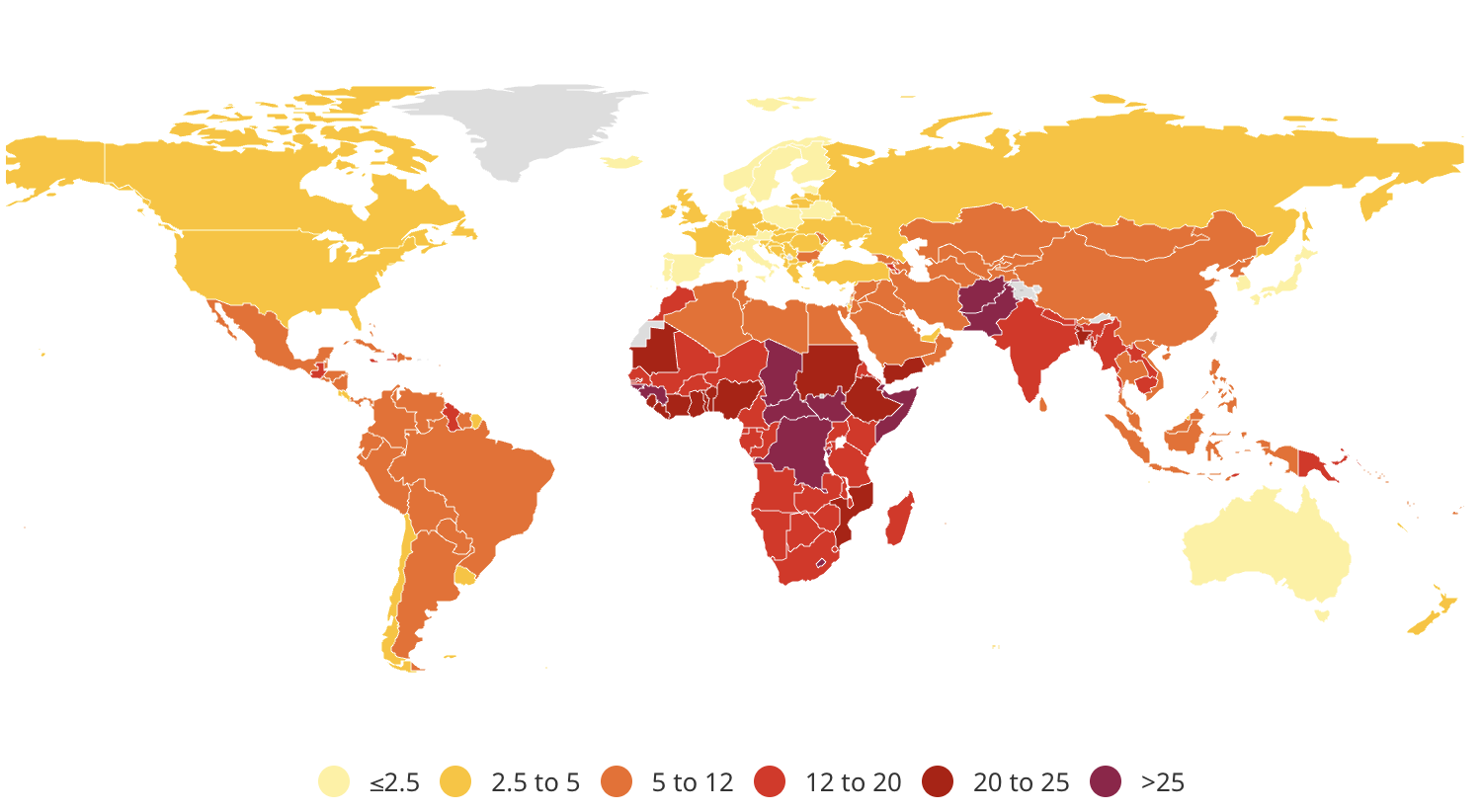
According to the latest UN Inter-Agency Group for Child Mortality Estimation (UN IGME) report, an estimated 1.9 million stillbirths occurred worldwide in 2023 — babies born with no sign of life at 28 weeks of pregnancy or later. This equates to a global stillbirth rate of 14.3 per 1,000 total births, or roughly 1 in 70 births ending in stillbirth — one occurring approximately every 17 seconds (Source: UNICEF Data, UN IGME Stillbirth Report 2024, United Nations Inter-agency Group for Child Mortality Estimation (UN IGME) 2020.).
Global Maternal & Newborn Health Statistics
Births, pregnancy loss, stillbirth, maternal mortality, and newborn mortality — a reference summary with primary sources.
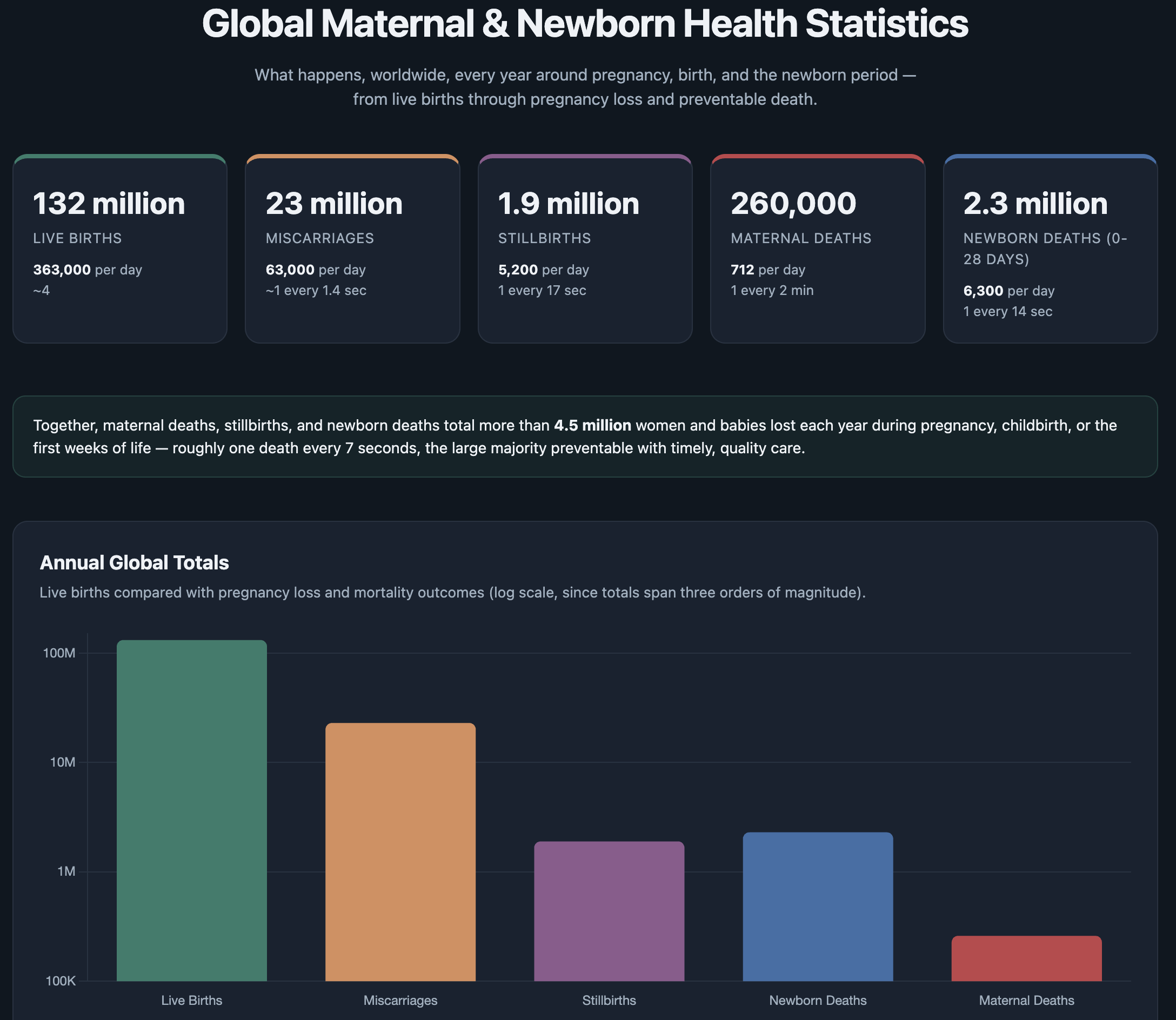
Global Number of Births Estimates
Around 132 million babies are born worldwide each year (2025 estimate), which works out to roughly 363,000 births per day, or about 4 births every second (Our World in Data, StatisticsTimes.com, UN World Population Prospects via IndexMundi).
This figure comes from UN World Population Prospects projections and has been fairly stable in recent years, though it’s expected to keep gradually declining as global fertility rates fall — birth totals are projected to peak around 2040–2045 at roughly 141 million per year before slowly declining afterward (Wikipedia).
Global Miscarriage Estimates
The most widely cited figure comes from a 2021 Lancet series, which estimated approximately 23 million miscarriages occur worldwide every year — roughly 44 every minute (The Lancet, University of Birmingham WHO Collaborating Centre).
In terms of risk per pregnancy, that same research puts the pooled risk of miscarriage at about 15.3% of all recognized pregnancies, and the WHO notes approximately one in four pregnancies ends in miscarriage (generally before 28 weeks) (PubMed, WHO). Estimates across sources vary somewhat depending on definitions and detection methods:
- 10–20% of known/recognized pregnancies, per a WHO 2018 systematic review that found overall spontaneous abortion prevalence of 16.1% among women with at least one pregnancy (journal-imab-bg)
- 1 in 10 women will experience a miscarriage in their lifetime, and about 1 in 4 will experience pregnancy loss over a lifetime (The Lancet)
- Roughly 80% of miscarriages occur in the first trimester, before 12 weeks (Wikipedia)
- A separate 2025 global burden analysis using GBD data estimated about 38.6 million pregnancy loss cases in 2021 (down from 47 million in 1990), reflecting a broader “maternal abortion and miscarriage” category and a declining incidence rate over time (PMC)
Given roughly 132 million live births occur globally each year, and miscarriage rates of 15–25% of recognized pregnancies, the 23 million figure lines up reasonably well as an order-of-magnitude estimate — though true numbers are likely undercounted since many early losses (before a pregnancy is even recognized) go unreported.
Global Stillbirth Statistics
According to the latest UN Inter-Agency Group for Child Mortality Estimation (UN IGME) report, an estimated 1.9 million stillbirths occurred worldwide in 2023 — babies born with no sign of life at 28 weeks of pregnancy or later. This equates to a global stillbirth rate of 14.3 per 1,000 total births, or roughly 1 in 70 births ending in stillbirth — one occurring approximately every 17 seconds (UNICEF Data, UN IGME Stillbirth Report 2024).
Key context
- This marks real progress: the rate has fallen 37% since 2000, when it stood at 22.6 per 1,000 births and totaled about 3.1 million stillbirths annually (UN IGME Report).
- The burden is highly uneven — nearly 80% of stillbirths occur in sub-Saharan Africa and Southern Asia, and 32% occur in low-income countries specifically (UNICEF Data).
- Nearly 900,000 of these (46%) are intrapartum stillbirths — deaths occurring during labor — which are largely preventable with timely, quality obstetric care (UN IGME Report).
- These figures likely undercount the true toll, since stillbirths are often underreported, especially in lower-resource settings; including earlier losses from 22 weeks onward (rather than the standard 28-week threshold) would raise the estimated total by about 40% (LSHTM).
- If current trends continue, nearly 13 million more babies are projected to be stillborn by 2030, with half of those deaths in sub-Saharan Africa (UNICEF Data).
For scale, that 1.9 million stillbirths sits alongside roughly 132 million live births and about 23 million miscarriages worldwide each year — together forming a substantial global burden of pregnancy loss that Maternl Companion’s bereavement resources could help address.
Global Maternal Mortality
According to the latest UN estimates, about 260,000 women died worldwide during and following pregnancy and childbirth in 2023 — equivalent to over 700 deaths per day, or roughly one maternal death every two minutes (WHO, UNICEF Data).
Key context
- This corresponds to a global maternal mortality ratio (MMR) of 197 deaths per 100,000 live births, down 40% from 328 in 2000 — an average annual reduction of about 2.2% (WHO).
- The burden is extremely concentrated: over 90% of maternal deaths occur in low- and lower-middle-income countries, with sub-Saharan Africa and Southern Asia together accounting for about 87% (225,000) of deaths — sub-Saharan Africa alone makes up roughly 70% (WHO).
- The disparity by income level is stark: the MMR in low-income countries was 346 per 100,000 live births versus just 10 per 100,000 in high-income countries (WHO).
- Conflict and fragility sharply increase risk — 37 countries classified as conflict-affected or fragile accounted for 61–64% of global maternal deaths despite representing only 25% of global live births, with an MMR of 504 per 100,000 in conflict zones (WHO, UNFPA).
- The global lifetime risk of maternal death for a 15-year-old girl in 2023 was estimated at 1 in 272 (UNICEF Data).
- Progress falls well short of the UN Sustainable Development Goal of under 70 deaths per 100,000 live births by 2030 — reaching that target would require roughly 15% annual reductions, a pace rarely achieved historically (WHO).
Combined with the roughly 1.9 million stillbirths and 23 million miscarriages each year, a 2023 UN report noted that over 4.5 million women and babies die annually during pregnancy, childbirth, or the newborn period — equivalent to one death every seven seconds, mostly from preventable or treatable causes (UN News).
Global Newborn Deaths
According to the latest UN Inter-agency Group for Child Mortality Estimation data, an estimated 2.3 million children died within their first 28 days of life (the neonatal period) in 2023 — approximately 6,300 neonatal deaths every day, or one every 14 seconds (UNICEF Data, UNICEF Child Mortality Report 2023).
Key context
- This corresponds to a global neonatal mortality rate of 17 deaths per 1,000 live births in 2023, down 53% from 37 per 1,000 in 1990 (UNICEF Data).
- Newborns now make up a growing share of all under-5 deaths — rising from 41% in 2000 to 47% in 2023 — even as overall child mortality has declined, since progress on neonatal survival has lagged behind gains for older children (UNICEF: Levels and Trends in Child Mortality 2024).
- Sub-Saharan Africa has the highest regional burden, with a neonatal mortality rate of 26 per 1,000 live births in 2023, followed by Central and Southern Asia at 21 per 1,000 (WHO).
- About 80% of newborn deaths stem from three largely preventable and treatable causes: complications of prematurity, intrapartum-related events (including birth asphyxia), and neonatal infections (UNICEF).
- Despite a 56% decline in neonatal deaths since 1990 (from 5.24 million to 2.3 million), the current rate remains well above the UN Sustainable Development Goal target of 12 or fewer deaths per 1,000 live births by 2030 (UNICEF Child Mortality Report 2023).
Taken together with the roughly 260,000 maternal deaths and 1.9 million stillbirths each year, this rounds out the picture of the roughly 4.5 million women and babies who die annually around pregnancy, birth, and the newborn period (UN News) — statistics squarely relevant to the global-health data the Maternl Companion platform is built to surface.
Global Maternal & Newborn Health Statistics Summary
| Metric | Annual Global Total | Rate | Key Source |
|---|---|---|---|
| Live births | ~132 million/year | ~363,000/day, ~4 per second | Our World in Data, UN World Population Prospects via IndexMundi |
| Miscarriages | ~23 million/year | ~44/minute; 15.3% of recognized pregnancies (up to 1 in 4 by some estimates) | The Lancet, WHO |
| Stillbirths (≥28 weeks) | ~1.9 million/year | 14.3 per 1,000 total births (1 in 70 births); one every 17 seconds | UNICEF Data, UN IGME Stillbirth Report 2024 |
| Maternal deaths | ~260,000/year (2023) | 197 per 100,000 live births; ~712/day; ~1 every 2 minutes | WHO, UNICEF |
| Newborn (neonatal) deaths (first 28 days) | ~2.3 million/year (2023) | 17 per 1,000 live births; ~6,300/day; one every 14 seconds | UNICEF Data |
The Bigger Picture
Together, maternal deaths, stillbirths, and newborn deaths add up to more than 4.5 million women and babies lost each year during pregnancy, childbirth, or the first weeks of life — equivalent to one death roughly every 7 seconds, the vast majority preventable with proper care (UN News).
Equity Gaps Across All Categories
A consistent pattern runs through every one of these statistics: outcomes are dramatically worse in low-income and fragile-state settings.
- Maternal mortality: 346 deaths per 100,000 live births in low-income countries vs. 10 per 100,000 in high-income countries — a 34-fold gap (WHO).
- Geographic concentration: Sub-Saharan Africa and Southern Asia together account for ~87% of maternal deaths and ~80% of stillbirths, despite representing a much smaller share of global births (WHO, UNICEF Data).
- Conflict impact: Countries in conflict or institutional fragility account for 61%+ of global maternal deaths while representing only 25% of global live births, with maternal mortality ratios roughly 5x higher than in stable, non-fragile settings (WHO).
- Preventability: ~80% of newborn deaths stem from three treatable causes (prematurity complications, birth asphyxia, infections), and most stillbirths and maternal deaths are also considered preventable with timely, quality obstetric care (UNICEF).
Progress and Targets
All four mortality-related metrics have declined substantially since 2000, though gains have slowed:
- Maternal mortality ratio down 40% since 2000 (328 → 197 per 100,000) (WHO)
- Stillbirth rate down 37% since 2000 (22.6 → 14.3 per 1,000) (UN IGME Report)
- Neonatal mortality rate down 53% since 1990 (37 → 17 per 1,000) (UNICEF Data)
None of these are on track to meet their 2030 UN Sustainable Development Goal targets (MMR under 70; stillbirth rate under 12; neonatal mortality under 12) at current rates of progress (WHO).
